
You bought an investment property in Tarneit five years ago. The rent covers most of the mortgage, the value has crept up nicely, and the plan was always to hold for the long haul and cash in down the track. Simple enough. Except the rules just changed underneath you.
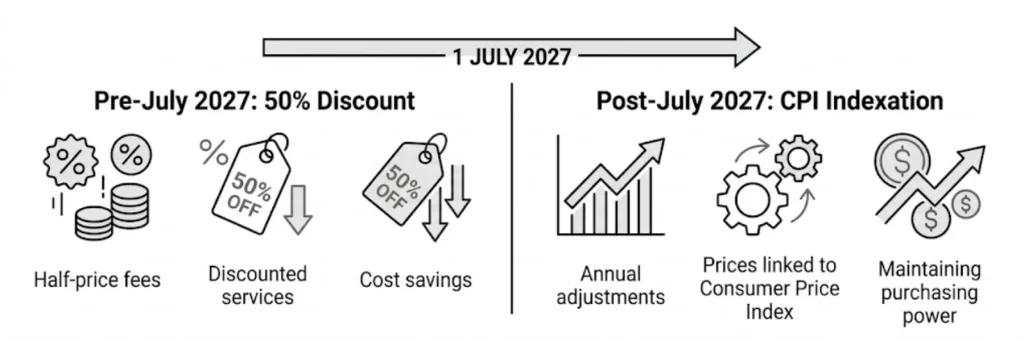
In June 2026, the Federal Government quietly passed a law that rewrites how capital gains tax works in Australia. From 1 July 2027, the 50 percent CGT discount that property investors have relied on since 1999 disappears entirely. What replaces it is a system that adjusts your cost base for inflation and slaps a 30 percent minimum tax on the gain. Whether that leaves you better off, worse off, or roughly the same depends on your property, your tax rate, and how long you plan to hold.
You do not need to panic. But you cannot afford to sit on your hands either. This article breaks down the capital gains tax Australia changes in plain English, explains who is actually affected, and lays out the three things every Melbourne property investor should get done in the next 12 months.
What Is Actually Changing (and When)
The Federal Government’s 2026-27 Budget introduced the most significant change to capital gains tax in Australia since the 50 percent discount was introduced back in 1999. The legislation, the Treasury Laws Amendment (Tax Reform No. 1) Act 2026, received Royal Assent on 26 June 2026. It is now law.
Here is what is changing from 1 July 2027:
- The 50 percent CGT discount is abolished for individuals, trusts, and partnerships across all CGT assets (not just property).
- Cost base indexation returns. Your cost base will be adjusted upward using the Consumer Price Index (CPI), so you only pay tax on your “real” gain above inflation. This is similar to the indexation method that applied in Australia between 1985 and 1999.
- A 30 percent minimum tax rate applies to net capital gains after indexation. If your marginal rate is below 30 percent, you pay 30 percent on the gain. If your marginal rate is already 30 percent or above, the minimum does not add anything extra.
What is not changing: the main residence exemption remains fully intact, and the four small business CGT concessions under Division 152 continue to apply. Self-managed super funds retain their one-third CGT discount.
The new rules apply to CGT events (typically property sales) from 1 July 2027 onward. If you sell before 30 June 2027, the current 50 percent discount still applies.
Transitional Splitting: The Part Most Investors Miss
Here is where it gets interesting, and where a lot of investors are caught off guard.
If you already own a CGT asset on 30 June 2027, the law treats it as though you sold and immediately repurchased it at market value on 1 July 2027. This creates a deemed sale that splits your total capital gain into two buckets:
- Pre-reform gain (accrued up to 30 June 2027): This portion retains the old 50 percent CGT discount.
- Post-reform gain (accrued from 1 July 2027 onward): This portion uses the new CPI indexation method and is subject to the 30 percent minimum tax.
This is why obtaining a formal market valuation at 1 July 2027 is now essential for every investment property you hold. It establishes the line between your old-rules gain and your new-rules gain.
A kerbside appraisal or a quick estimate from your real estate agent will not cut it. The ATO will expect a defensible, independent market valuation that can substantiate your pre-reform cost base. This means a valuation prepared by a certified property valuer, with comparable sales evidence and a written report you can produce if the ATO ever queries your return.
If you hold property across Melbourne’s western growth corridor, including suburbs in the Wyndham area, it is worth speaking with a Wyndham tax specialist who understands the distinct investment profile of these capital-growth suburbs versus higher-yield outer areas.
Is Indexation Actually Better or Worse Than the 50 Percent Discount?
This is the question every investor is asking, and the honest answer is: it depends on your property.
Under the old system, regardless of how long you held an asset or how much inflation occurred, you simply halved the capital gain. That flat 50 percent discount was generous in low-inflation environments and for shorter holds where the nominal gain was not large.
Under the new indexation method, the benefit grows with time and inflation. Treasury modelling suggests that effective discounts under indexation would have ranged from approximately 35 to 60 percent for typical assets held between five and ten years, had the new rules been in place over the past two decades (Treasury, Budget Paper No. 2, 12 May 2026).
Consider the logic:
- For short holds in low-inflation periods, the old 50 percent discount was almost always more generous. A small nominal gain halved still beats a CPI adjustment of only a few percent.
- For longer holds or periods of higher inflation, indexation can actually outperform the discount. If you bought a Melbourne property in 2010 and held it through periods where CPI ran at 4 to 5 percent annually, the cumulative indexation on your cost base could exceed what the 50 percent discount would have saved you.
The practical takeaway: do not assume the new system is automatically worse. For many long-term Melbourne investors, especially those who bought during Melbourne’s softer periods and have seen strong capital growth, the numbers may land closer to neutral than you expect.
The 30 Percent Minimum Tax: Who It Actually Hits
The 30 percent minimum tax is not an additional tax layered on top of your income tax. It works as a floor.
If your marginal tax rate on the capital gain (after indexation) would otherwise fall below 30 percent, the minimum lifts your effective rate to 30 percent. If your marginal rate is already at or above 30 percent, the minimum has no impact whatsoever.
Who is unaffected:
- Income support recipients including Age Pension, Disability Support Pension, and JobSeeker recipients are explicitly exempt from the 30 percent minimum.
- SMSF investors retain their existing one-third discount and are outside the scope of these changes.
- Higher-rate taxpayers whose marginal rate already exceeds 30 percent will see no change from the minimum, though they will feel the shift from discount to indexation.
The investors most affected by the minimum tax are those who had been timing asset sales to fall in low-income years to access lower marginal rates on their capital gains. That strategy becomes less effective from 1 July 2027 onward.
Should You Sell Before July 2027? A Decision Framework, Not a Directive
With Domain forecasting Melbourne house prices to fall between 4 and 8 percent across 2026-27 (Domain FY2027 Forecast, July 2026), and the CGT rules shifting mid-year, it is natural to wonder whether selling before the deadline makes sense.
Rather than giving you a blanket “sell” or “hold” recommendation, here is a framework to work through with your accountant:
- Your purchase date and current cost base. The longer you have held, the more pre-reform gain you have locked in under the old discount rules.
- Expected capital growth versus CPI. If your property’s growth rate is close to or below CPI, indexation may reduce much of the taxable gain under the new system.
- Your current and projected marginal tax rate. This determines whether the 30 percent minimum actually bites.
- Negative gearing grandfathering. Residential investment properties acquired before Budget night (7:30pm AEST, 12 May 2026) are grandfathered for negative gearing purposes. If you sell and repurchase, you lose this protection.
- Market conditions in your corridor. Melbourne’s western suburbs, including growth areas around Wyndham and Point Cook, have a different risk profile to established inner-ring suburbs. Capital growth patterns, rental yields, and buyer demand all vary.
The right answer depends on your numbers. Model it with your Melbourne tax accountant before making any decisions.
The 3 Things Worth Doing Before July 2027
Whatever you decide about selling or holding, three steps are worth taking now:
- Get a formal market valuation at 1 July 2027 for every CGT asset you hold. This is non-negotiable. The valuation establishes the split between your pre-reform and post-reform gains. Commission a certified valuer and keep the report on file.
- Model your likely CGT outcome under both the old and new systems with your accountant. Compare what you would owe if you sold under the current discount versus what the new indexation and minimum tax would produce over your expected holding period. This gives you a clear, numbers-based picture rather than guesswork. If you are a higher-income earner, this pairs well with a broader tax reduction strategy.
- Review whether your ownership structure still makes sense under the new rules. Holding property in your personal name, through a discretionary trust, in a company, or within an SMSF each produces different CGT outcomes under the reformed system. The right structure before the reform may not be the right structure after it. MaxMargin Accountants can help you assess whether a trust structure or other entity better suits your position going forward.
Common Questions About the CGT Changes
Does this affect my family home? No. The main residence exemption is unchanged. If you live in the property as your primary home, it remains fully exempt from CGT.
I bought my investment property in 2019. Am I affected? Yes, if you sell after 30 June 2027. Your gain will be split: the portion accrued up to 30 June 2027 receives the old 50 percent discount. The portion accrued after 1 July 2027 is subject to the new indexation method and minimum tax.
Is the 30 percent minimum tax on top of my income tax? No. It works as a floor. If your marginal rate on the gain is below 30 percent, the minimum brings you up to 30 percent. If your marginal rate is already above 30 percent, the minimum does not add anything extra.
Do I really need a formal valuation? Yes. The ATO will expect a defensible market valuation at 1 July 2027 to substantiate your pre-reform cost base. A kerbside appraisal or an estimate from a property listing site is not sufficient. A valuation by a certified practising valuer with comparable sales evidence is the standard you should aim for.
What about Victoria’s off-the-plan stamp duty concession? Investors purchasing off-the-plan in Victoria can still access the stamp duty concession, but the interaction with the new CGT rules and the negative gearing restrictions for existing dwellings purchased after Budget night means the financial modelling has changed. Run the numbers with your accountant before committing.
Not sure where you stand? The team at MaxMargin Accountants can model your CGT position and help you make a confident call before July 2027. Get in touch today.