
The May 2026 Federal Budget changed the negative gearing rules for established residential property, and since then, the question we hear most from Melbourne investors is a simple one: what should I actually be doing right now?
It is a fair question. There is plenty of commentary out there explaining what changed, but very little that tells you what to do about it. That is what this article is for. You have roughly 10 months before the new rules take effect on 1 July 2027, and that is more than enough time to understand the changes, check your position, and put a plan together.
Below, we walk through how the new negative gearing rules work, who is protected, what counts as a new build, and the practical steps worth taking before the deadline.
What Is Negative Gearing in Plain English?
Negative gearing happens when the costs of holding an investment property are higher than the rent it brings in. Those costs include loan interest, council rates, property management fees, insurance, repairs and depreciation.
Under the current rules, the resulting loss reduces your total taxable income, including your salary. If your property generates a $10,000 loss in a financial year and you earn $100,000 in wages, you only pay tax on $90,000.
That tax saving is the reason negative gearing has been one of Australia’s most popular wealth-building strategies for decades. According to ATO Taxation Statistics (FY2022-23 data), close to half of Australia’s 2.26 million property investors, around 1.1 million people, were negatively geared in FY2022-23, claiming a combined $10.4 billion in net rental losses.
For a more detailed look at how property investors can structure their tax returns, our property investors page outlines the key deductions and compliance obligations.
What Changed in the May 2026 Budget and When It Starts
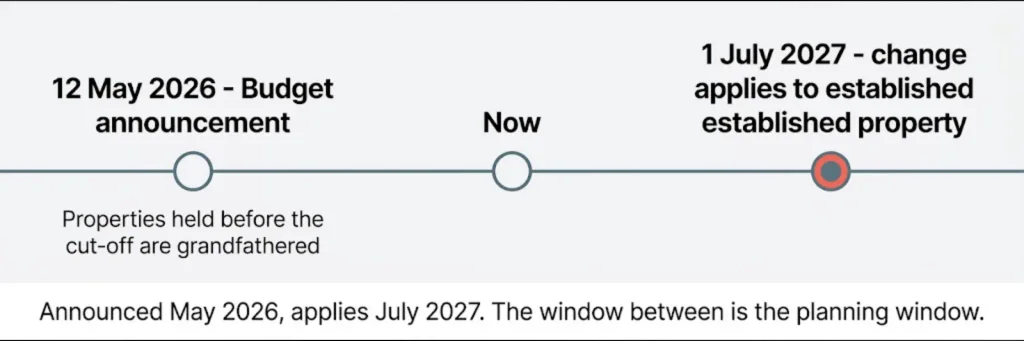
The Federal Government announced that negative gearing for established residential investment properties will be restricted from 1 July 2027. The restriction applies to properties purchased after 7:30 pm AEST on 12 May 2026 (Budget night). Full details are set out in the ATO’s guidance on the negative gearing and CGT reform.
Here is what the change means in practice:
- From 1 July 2027, if you bought an established residential property after 7:30 pm on 12 May 2026, you can no longer offset your rental losses against your salary, wages or other non-property income.
- Rental losses on affected properties can only be deducted against residential rental income (from any of your rental properties) or capital gains from the sale of a residential rental property.
- If your rental losses still exceed your residential property income in a given year, the excess is carried forward to future years.
The Budget also replaced the 50% capital gains tax (CGT) discount with cost base indexation and a 30% minimum tax rate, applying to gains that accrue from 1 July 2027. For a full breakdown of the CGT changes and what they mean for your portfolio, read our companion article on the changes to the capital gains tax discount.
Note: Between Budget night (12 May 2026) and 30 June 2027, established properties purchased in that window can still be negatively geared under the current rules. The restriction kicks in on 1 July 2027.
Grandfathering: Who Is Protected
If you already held a residential investment property at 7:30 pm AEST on 12 May 2026, you are grandfathered. This includes properties that were under contract but had not yet settled at the time of the announcement.
What grandfathering means for you:
- You can continue to negatively gear that property under the existing rules for as long as you own it.
- The current 50% CGT discount continues to apply to any capital gains that accrued before 1 July 2027.
- You do not need to do anything differently with that property unless you sell it and re-enter the market after the cut-off.
The critical detail is the contract date, not the settlement date. If your contract was signed before 7:30 pm AEST on 12 May 2026, you are covered.
Tip: Locate and file your original contract of sale. If the ATO ever queries your grandfathered status, the contract date is your proof.
The New-Build Exemption and What Counts as a New Build
This is where many investors see opportunity. Eligible new builds are completely exempt from the negative gearing restrictions. If you purchase a qualifying new build, you can continue to offset rental losses against your salary and other income, exactly as you can today. Investors in new builds can also choose between the existing 50% CGT discount and the new indexation method when they sell.
What qualifies as an eligible new build:
- A newly constructed dwelling built on previously vacant land
- An off-the-plan apartment
- A house-and-land package
- A duplex or multi-dwelling development built through a knock-down rebuild where the number of dwellings on the site increases
What does not qualify:
- A one-for-one knock-down rebuild (replacing one house with one house)
- Substantial renovations or extensions to an existing property that do not increase the number of dwellings
- A granny flat added to an established property
- A property that has been previously sold, unless it was first owned by the builder and not occupied for more than 12 months
The government has been specific about this definition because the policy is designed to direct investor demand towards new housing supply. The Budget 2026-27 tax reform page outlines the full eligibility criteria. If you are considering a new build, confirm the property’s eligibility with your accountant before signing a contract.
How the Loss Quarantine Works
For established properties caught by the new rules, your rental losses are not gone. They are quarantined.
Here is how it works from 1 July 2027:
- Step 1: Calculate the net rental result across all your residential investment properties (both new builds and established) for the financial year.
- Step 2: If you have a net rental loss on an affected established property, you can offset that loss against rental income from your other residential properties, including capital gains from selling a rental property.
- Step 3: Any remaining losses that cannot be absorbed are carried forward to future income years and offset against residential property income in those years.
The key point: your rental property deductions are deferred, not denied. You will eventually claim them, but you cannot use them to reduce your salary income in the year the loss is incurred. For investors who rely on the annual tax refund to support cash flow, this is a meaningful shift.
Should You Hold, Restructure or Buy? A Decision Framework
Every investor’s situation is different, and this is not financial advice. But there are three broad paths worth thinking through with a qualified tax accountant in Melbourne.
Hold your existing property. If your property was purchased before the Budget night cut-off, your negative gearing is fully protected. There may be no reason to change anything. Running a projection of your rental income against expected expenses over the next five to ten years will tell you whether the property is trending towards positive gearing anyway, which would reduce the significance of the changes for your situation.
Review your ownership structure. For investors who hold multiple properties or are acquiring new ones, the ownership structure matters more than ever. Holding properties through the right entity, whether that is in your personal name, a trust or a company, affects how losses are quarantined and how capital gains are taxed. Our article on choosing the right business structure covers the broader considerations, and a property-specific review with your accountant is worthwhile before 30 June 2027.
Consider a new-build purchase. New builds remain fully eligible for negative gearing. If you were planning to expand your portfolio, a new build in Melbourne’s growth corridors, including areas like Wyndham Vale, Tarneit and Point Cook, may offer both tax efficiency and long-term capital growth. Off-the-plan apartments and house-and-land packages are worth modelling, but confirm the property meets the ATO’s new-build definition before committing.
Three Things to Do in the Next 12 Months
You do not need to make every decision today, but you should start preparing now.
- Run the numbers. Model your rental income and expenses under both the current rules and the new loss-quarantine rules. Understand the cash flow impact of losing the ability to offset losses against your salary. A registered tax agent can prepare this comparison for you.
- Review your ownership structure. If you hold properties across different entities, or if you are considering purchasing a new property, check that your structure is optimised for the post-July 2027 environment. Do this well before 30 June 2027 so any changes can be implemented in time.
- Model a new-build purchase. If expanding your portfolio makes sense, compare the after-tax position of a new build (with full negative gearing) against an established property (with quarantined losses). A side-by-side model will make the trade-offs clear. For broader strategies on reducing your tax bill, our guide to tax reduction strategies for high-income earners is a useful starting point.
Tips for the next 10 months:
- Get a written rental-loss breakdown for each property you own, showing income, expenses and the net result
- Confirm your contract date against the 7:30 pm AEST, 12 May 2026 cut-off, and keep a copy of the contract accessible
- If you are considering a new-build purchase, verify the ATO’s new-build definition applies to the specific property
- Model your tax position under both sets of rules so you can see the dollar difference
- Book an ownership-structure review with your accountant before 30 June 2027
The changes to negative gearing are significant, but they are not a reason to panic. With 10 months to prepare, Melbourne property investors have time to get clear on the facts, model the impact and make well-informed decisions. If you need help running the numbers or reviewing your structure, get in touch with our team for a tailored plan.
FAQs
Does this affect my family home?
No. The main residence exemption is completely unchanged. These reforms apply only to residential investment properties.
I bought my investment property before Budget night. Am I safe?
Yes. Properties held at 7:30 pm AEST on 12 May 2026, including those under contract awaiting settlement, are fully grandfathered.
Are new builds still exempt?
Yes. Eligible new builds retain full access to negative gearing and the option to choose between the existing 50% CGT discount and the new indexation method.
Are my interest deductions gone?
No. You can still claim interest, repairs, depreciation and other rental property deductions. The change is about when and against what income those deductions can be applied if they result in a net loss.