GST registration is one of those things that sounds straightforward until you sit down and try to work out whether it actually applies to you. The threshold is $75,000, but how exactly is it measured? What counts towards it? And what happens if you cross it without realising?
These are the questions we get asked constantly by sole traders, freelancers and small business owners across Melbourne’s west. Whether you are a tattoo artist in Hoppers Crossing trying to make sense of the rules, or a tradie in Point Cook whose jobs have picked up faster than expected, this guide covers what you need to know in plain English.
The One Number That Matters: $75,000
The GST registration threshold for most Australian businesses is $75,000 in GST turnover over a rolling 12-month period. Non-profit organisations have a higher threshold of $150,000.
If your business hits or exceeds $75,000 in GST turnover, registration with the ATO is mandatory. If you are under the threshold, registration is optional. That is the starting point. The detail is in how that $75,000 is measured, and that is where most people get tripped up.
To put the scale of this in perspective, the Australian Small Business and Family Enterprise Ombudsman (ASBFEO) reports there were 2,741,087 actively trading small businesses in Australia as at 30 June 2026. The vast majority of these are required to navigate the GST threshold question at some point.
You can find the full rules on the ATO’s GST registration page, and we have outlined the key points below.
The Rolling 12-Month Test and the 21-Day Window
The $75,000 threshold is not based on the financial year. It uses a rolling 12-month window, and the ATO applies two tests:
- Backward-looking test: your gross business income for the current month plus the previous 11 months. This tells you what you have already earned.
- Forward-looking test: your gross business income for the current month plus the next 11 months. This is based on what you reasonably expect to earn.
If either figure reaches $75,000, you must register for GST within 21 days of becoming aware you have crossed (or will cross) the threshold.
That forward-looking test is the one that catches people out. If you land a big contract, pick up a regular client or have a strong quarter, your projected turnover could push past $75,000 even if last year’s total was well under. The ATO expects you to monitor this as you go, not wait for your end-of-year review.
What happens if you miss the 21-day window? The ATO can backdate your registration to the date you should have registered (up to four years). That means you will owe GST on every sale made since that date, even if you never charged your customers GST. On $80,000 of sales, that is roughly $7,273 in GST (calculated as 1/11th of GST-inclusive revenue) coming straight out of your pocket. Penalties and interest can apply on top.
What Counts as GST Turnover and What Does Not
GST turnover is your gross business income from taxable supplies, excluding GST itself. It is not your profit and it is not your total bank balance.
Counts towards GST turnover:
- Income from providing services (consulting, design, trades, therapy, etc.)
- Income from selling goods
- Commissions and fees
Does not count towards GST turnover:
- Input-taxed sales (e.g. residential rent, some financial supplies)
- Sales that are not for payment
- Sales not connected with Australia
- Wages or salary from employment
- Hobby income or one-off personal sales (e.g. selling your old car)
The distinction between a business activity and a hobby matters here. If you are regularly selling goods or services with the intention of making a profit, the ATO is likely to treat it as a business, even if you have not formally registered one. If your small business income is approaching the threshold, track it monthly so you are not caught off guard.
The Rule Most People Miss: Taxi and Rideshare Drivers Register From Day One
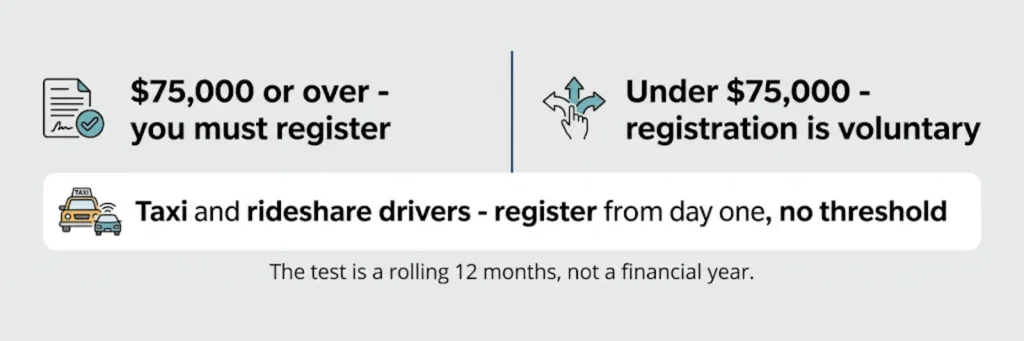
This one catches a lot of part-time drivers. If you provide taxi travel, limousine travel or ride-sourcing services (Uber, DiDi, Ola or similar), you must register for GST before your first fare, regardless of how much you earn.
There is no $75,000 threshold for this category. Even if you only drive a few hours on weekends, GST registration is mandatory from day one. The ATO is very clear on this, and it applies whether you drive full-time or as a side income alongside your regular job.
If you are considering signing up with a rideshare platform, factor GST into your pricing from the start. You will need to charge 10% GST on every fare and lodge regular BAS returns.
Voluntary Registration: When It Helps and When It Does Not
If your turnover is below $75,000, you can still choose to register for GST voluntarily. Whether that makes sense depends on your business.
Voluntary registration can help when:
- Your business expenses are high relative to income (e.g. a startup buying equipment, fit-out or stock), because you can claim back the GST on those purchases as input tax credits
- Your clients are other businesses that expect suppliers to be GST-registered
- You want your business to appear more established and professional
Voluntary registration may not help when:
- Most of your customers are individuals (B2C) who will see a 10% price increase
- Your business expenses are low (e.g. a service-based freelancer with minimal overheads), meaning there is little GST to claim back
- You do not want the administrative commitment of BAS lodgement every quarter
One important rule: if you register voluntarily, you must generally stay registered for at least 12 months unless your business ceases. Talk to a tax accountant in Melbourne before making the call, because once you are in, you are in for at least a year.
What You Commit to Once You Register
GST registration is not just a box you tick. It changes how you operate day to day. Here is what you take on:
- Charge 10% GST on all taxable goods and services you sell, from your registration date onwards
- Issue tax invoices that show your ABN, the GST amount and the total price including GST
- Lodge a Business Activity Statement (BAS) on a regular cycle, usually quarterly for small businesses
- Keep records of all sales and purchases for at least five years
- Choose an accounting method: cash basis (record GST when money changes hands) or accruals (record GST when invoices are issued). Most small businesses start with cash basis as it is simpler and aligns with actual cash flow
If you are already lodging BAS for PAYG withholding or other reasons, adding GST is a natural extension. If BAS is new to you, our GST services page walks through how we help Melbourne businesses manage their GST obligations.
How an Accountant Takes the Guesswork Out of the Decision
GST registration is one of those decisions that looks simple on paper but gets complicated in practice. The rolling 12-month test, the forward-looking projection, the voluntary registration trade-offs and the BAS obligations all interact with your specific business situation.
A registered tax agent can:
- Review your rolling 12-month turnover and tell you exactly where you stand against the threshold
- Model whether voluntary registration would result in a net benefit or a net cost for your business
- Set up your BAS reporting and accounting software so GST is handled correctly from day one
- Make sure your invoices, record-keeping and reporting meet ATO requirements
If you are a sole trader or small business owner in Melbourne’s west and you are not sure where you sit, an accountant in Hoppers Crossing or anywhere across our service area can review your position in a single consultation. For a broader look at how the right support makes a difference, our article on choosing between a tax accountant and DIY lays out the comparison.
Tips for staying on top of GST:
- Track your rolling 12-month turnover monthly, not just at tax time. A simple spreadsheet is enough
- Set a calendar reminder at 21 days if you cross or expect to cross $75,000
- Open a separate bank account for GST collected so the money is there when your BAS is due
- Understand whether cash or accruals accounting suits your business before you register
- Talk to a registered tax agent before voluntarily registering so you understand the full commitment
If you need help working out whether GST registration is right for your business, or if you have already crossed the threshold and need to get set up, our team is here to walk you through it. Visit our EOFY checklist for sole traders for more practical guidance, or get in touch to book a review.
FAQs
Do I charge GST on everything from the day I register?
You charge GST on taxable sales from your registration date going forward. You do not need to go back and charge GST on sales made before your registration date.
I earn under $75,000. Do I need to register?
Generally, no. GST registration is optional below the threshold. But voluntary registration can make sense if your business expenses are high or your clients expect it. Weigh it up with your accountant first.
What about rideshare drivers?
There is no turnover threshold for taxi, limousine or ride-sourcing drivers. You must register before your first fare, regardless of income.
What happens if I register late?
The ATO can backdate your registration to the date you should have registered. You will owe GST on all sales in that period, even if you did not charge it. Interest and penalties may also apply.