You bought a new laptop for the business. Or maybe it was a coffee machine for the cafe, a pressure washer for the tradie van, or a secondhand ute you found on Facebook Marketplace. Someone told you to “just write it off.” Easy, right? Not quite. The instant asset write-off is one of the most useful small business tax deductions in Australia, but it comes with rules that trip people up every year. Claim something that does not qualify, get the timing wrong, or miss the threshold by a few dollars, and you could end up on the wrong end of an ATO review.
The good news is the rules have finally stabilised. After years of temporary extensions and last-minute Budget night renewals, the Federal Government has committed to making the $20,000 instant asset write-off permanent from 1 July 2026. That means small business accounting in Melbourne (and everywhere else in Australia) just got a little more predictable. Here is how to make the most of it.
What the $20,000 Instant Asset Write-Off Actually Is
In simple terms, the instant asset write-off lets eligible small businesses deduct the full cost of an asset in the same financial year they start using it, rather than depreciating it over several years.
To qualify, your business must have an aggregated annual turnover of less than $10 million, and you need to be using the simplified depreciation rules. The asset must cost less than $20,000 (GST exclusive if you are registered for GST), and it must be first used or installed ready for use during the income year you are claiming.
The $20,000 threshold applies per asset, not per business. So if you buy a $15,000 trailer and a $12,000 computer setup in the same year, both qualify. You can write off as many eligible assets as you like, as long as each one individually comes in under $20,000.
This measure was announced as permanent from 1 July 2026 in the 2026-27 Federal Budget (12 May 2026). The enabling legislation, the Treasury Laws Amendment (Tax Reform No. 2) Bill 2026, is currently before Parliament. The Government has committed to the measure and it is widely expected to pass, but it is worth noting it is not yet formally enacted. Your small business accountant in Melbourne can keep you updated on the status.
For context, up to 4.1 million Australian small businesses stand to benefit from this permanent extension, according to the Treasurer’s second reading speech (25 June 2026).
What Qualifies and What Does Not
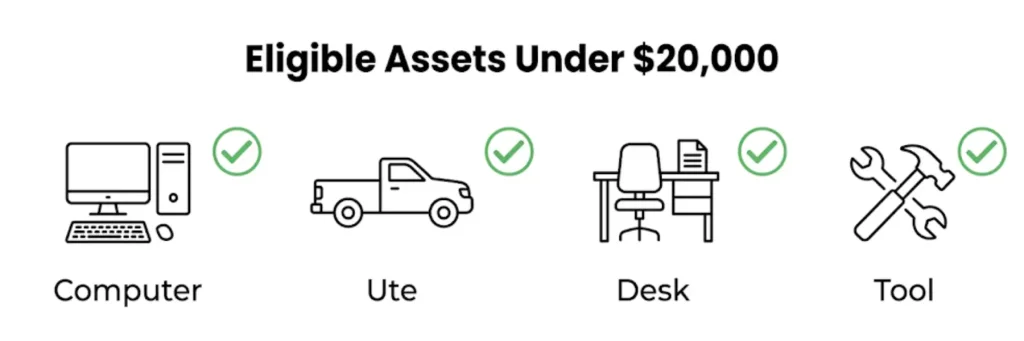
The write-off applies to depreciating assets used in your business. Here is a quick breakdown.
Assets that typically qualify:
- Tools and equipment
- Computers, laptops, and tablets
- Office furniture (desks, chairs, shelving)
- Point-of-sale systems
- Work vehicles (subject to the car limit, covered below)
- Small machinery and appliances
- Shop fit-out items (counters, display units, signage)
Assets that do not qualify:
- Buildings and structural improvements (these fall under Division 43 capital works)
- Trading stock (items you buy to sell)
- Software that is not classified as a depreciating asset
- Assets leased to another party
- Horticultural plants
- Assets connected to land improvements
The threshold is strict. A $19,500 piece of equipment qualifies. A $20,100 piece does not. If your asset costs $20,000 or more, it still gets depreciated, just not instantly. It goes into the small business simplified depreciation pool at 15 percent in the first year and 30 percent each year after that.
The Car Limit: The Detail Most People Miss
This is where a lot of business owners get confused. If you are buying a passenger vehicle (a car, SUV, or similar), a separate cap applies on top of the $20,000 threshold.
For the 2026-27 financial year, the ATO car depreciation limit is $69,883 (ATO, Car Thresholds from 1 July, published June 2026). This is the maximum value you can use when calculating depreciation on a passenger vehicle, regardless of what you actually paid.
So if you buy a $45,000 SUV for business use and it costs under $20,000… well, it does not. But here is where the car limit matters more broadly: if you buy a $90,000 vehicle, you can only depreciate up to $69,883. And even then, you cannot instantly write off the full amount under the $20,000 threshold because the car costs well above $20,000.
Where the instant write-off does apply to vehicles: commercial vehicles (utes with a payload over one tonne, vans, trucks) are not subject to the car limit. A $18,000 secondhand work ute that is classified as a commercial vehicle can be written off in full, provided it meets all other eligibility requirements.
If you are unsure whether your vehicle counts as a car or a commercial vehicle under the ATO’s definition, get local business tax advice before you buy.
Timing Your Purchases: Financial Year Strategy
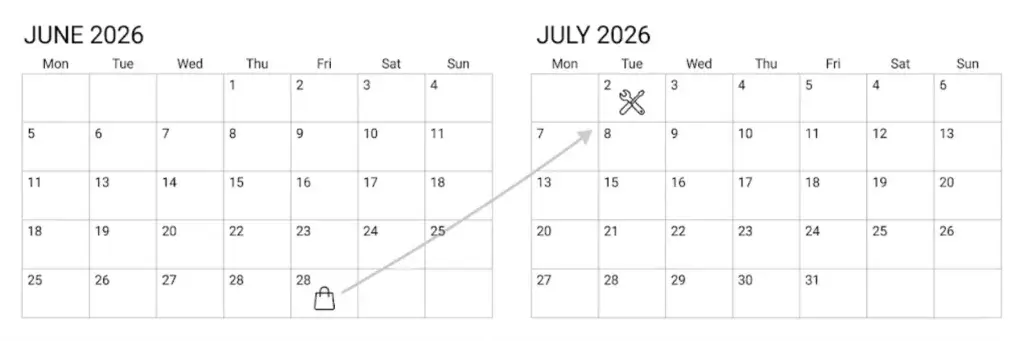
The write-off is claimed in the income year the asset is first used or installed ready for use. Not when you pay for it. Not when it is delivered. When it is actually ready to go.
This distinction matters more than most people realise.
- You order a new commercial oven on 25 June 2027. It arrives and gets installed on 4 July 2027. The deduction falls in the 2027-28 financial year, not 2026-27.
- You buy a laptop on 3 July 2026 and use it the same day. That deduction sits in 2026-27.
For businesses with uneven income, timing can make a real difference to your tax bill. If you had a particularly strong year with higher-than-usual profits, bringing a planned purchase forward into that year means the deduction offsets income taxed at a higher marginal rate. If it was a quieter year and your taxable income is low, the deduction may be partly wasted because there is less tax to offset.
Now that the write-off is permanent, you do not have to rush purchases into the current financial year out of fear the threshold might disappear. You can plan purchases across multiple years based on your actual business needs and cash flow, which is exactly how small business tax deductions in Australia should work.
The CGT Catch: What Happens When You Sell the Asset
Here is something most people do not think about until it is too late.
When you instantly write off an asset, its cost base drops to zero. That means if you sell the asset later, the entire sale proceeds can be treated as a taxable capital gain.
Say you write off a $15,000 piece of equipment in full. Three years later, you sell it for $6,000. Because the cost base is zero, that $6,000 is a capital gain. If you are eligible for the small business CGT concessions, you may be able to reduce or eliminate that gain, but you need to check with your accountant first.
This is not a reason to avoid the write-off. The immediate tax saving almost always outweighs the future CGT. But it is a reason to keep proper records and talk to your accountant before selling any asset you have previously written off. The team at MaxMargin Accountants can help you weigh up the trade-off.
5 Rules to Get the Write-Off Right
If you remember nothing else from this article, remember these five things:
- Confirm your aggregated turnover is under $10 million. “Aggregated” means connected entities and affiliates count together. If you run multiple businesses or have related entities, the combined turnover is what matters.
- Check the per-asset cost is under $20,000 (GST exclusive if you are registered for GST). A $19,999 asset qualifies. A $20,000 asset does not. If you are not registered for GST, the threshold applies to the GST-inclusive price.
- Make sure the asset is installed and ready for use by 30 June of the claim year. Purchased is not enough. Delivered is not enough. It must be ready to use in your business.
- Keep the purchase invoice and a record of when the asset was first used. The ATO can ask for evidence, and “I think it was around June” will not cut it. A diary note, a photo with a date stamp, or a commissioning record all work.
- Remember the CGT implication when you sell. Talk to your accountant before disposing of any asset you have written off. The tax reduction strategies available to higher-income earners may also interact with how you structure asset purchases and disposals.
Common Questions About the Instant Asset Write-Off
Can I claim the write-off for a secondhand asset? Yes. There is no requirement for the asset to be brand new. Secondhand assets qualify, provided they meet the cost threshold and are first used in the relevant income year.
What if the asset is used for both business and personal purposes? You can only claim the business-use portion. If you buy a $10,000 laptop and use it 60 percent for business, the deductible amount is $6,000.
Can I claim multiple assets in the same year? Yes. The $20,000 threshold applies per asset. You can claim as many qualifying assets as you like in a single financial year.
Does the write-off apply to sole traders? Yes. Sole traders, partnerships, companies, and trusts can all access the write-off, provided they meet the turnover and eligibility criteria.
The permanent instant asset write-off is genuinely good news for small businesses, but timing and eligibility still matter. If you are planning a purchase and want to make sure you claim it correctly, the team at MaxMargin Accountants can help you get it right.