
Under payday super, which started on 1 July 2026, employers pay super guarantee for each payday, and the money must be received by each employee’s super fund within 7 business days after payday. That replaces the old quarterly system, so this is the first October in years without a 28 October super deadline for the July to September quarter.
Below, we set out what changed, the detail that catches most employers out, and what to do if super for pay runs since 1 July has been held back for the old date.
What changed with payday super on 1 July 2026
The Australian Taxation Office (ATO) publishes its own side-by-side comparison. Here are the parts that matter most for a small business pay run:
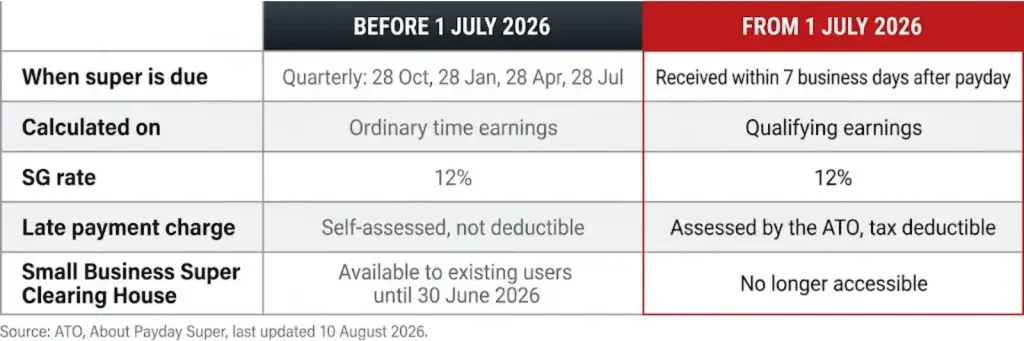
Source: ATO, About Payday Super, last updated 10 August 2026.
A few points behind the table:
- Qualifying earnings bring together ordinary time earnings, all commissions, salary sacrifice contributions and other amounts previously included in salary or wages for super guarantee.
- Reporting now means sending both qualifying earnings and super liability through Single Touch Payroll each payday.
- The last quarterly payment was for the June 2026 quarter, due 28 July 2026. The ATO says contributions received on or after 29 July are applied under the new rules (ATO, managing the changeover, last updated 10 August 2026).
“Received”, not “sent”
This is the part most employers ask about. The 7 business days are counted after payday, and the deadline is about when the fund receives the contribution, with enough information to allocate it to the employee’s account. Pressing “pay” on day six is not the same as being on time.
Everything between your payroll and the fund counts against those 7 days:
- clearing house processing time
- bank transfer time
- fixing any errors, such as a wrong member number or fund details
Some help has arrived alongside the change. Funds now have 3 business days to allocate or return a contribution (previously 20), the New Payments Platform allows near real-time payments, and a new member verification request lets you confirm a fund will accept a first contribution before you send it.
The ATO’s own example shows how tight this is: a Monday 6 July payday had a super deadline of Wednesday 15 July. For that reason, the ATO’s guidance points employers towards paying super on payday, not after.
The Small Business Superannuation Clearing House has closed
The Small Business Superannuation Clearing House (SBSCH) closed to new users on 1 October 2025 and is no longer accessible from 1 July 2026.
If you used it, you will now be paying super another way, usually through your payroll software or a separate clearing house. Whichever option you use, the useful questions are the same:
- How many business days does it take for a payment to land in the fund?
- Does it use the New Payments Platform?
- Where do error messages appear, and who sees them?
If you are reviewing your set-up, our comparison of accounting software that handles super covers Xero, MYOB and QuickBooks.
If you have been saving it up for 28 October
Some businesses have kept running super the old way, holding July, August and September contributions for a single payment in late October. Under payday super, most of those pay runs have already passed their 7-business-day window.
Here is what the ATO says applies when super is not received on time:
- The super guarantee charge applies, calculated on qualifying earnings and now assessed by the ATO, so you no longer lodge a super guarantee statement for these pay runs.
- Interest compounds daily at the general interest charge rate.
- An administrative uplift amount is added. The ATO says it can be reduced if the ATO has not taken action in the past and the employer lodges a voluntary disclosure statement.
- Penalties are 25% or 50% of unpaid super guarantee charge, depending on prior penalties (previously up to 200%).
The ATO has also said that in the first year it will not focus compliance action on employers who pay for each payday on time and fix errors quickly, but it will take a firmer approach with employers who are not attempting to pay for each payday.
The calm next step is to work out which pay runs since 1 July are affected and get advice before deciding how to fix them. This is general information only, so talk to a registered tax agent about your situation.
New starters and contractors
Two groups have their own rules:
- New employees. The first super contribution for a new employee has to be made within 20 business days of their wages being paid, according to the Fair Work Ombudsman (updated 3 February 2026). After that, the usual 7 business days apply.
- Contractors. The ATO says you still pay super for independent contractors paid mainly for their labour. Payday super changes the timing, not who you pay for.
What stays the same
Not everything has moved. Under payday super:
- the super guarantee rate is still 12%
- who you pay super for has not changed
- the systems and SuperStream platforms you use are the same, apart from the closed SBSCH
The Fair Work Ombudsman also notes that late payment of super may breach the Fair Work Act or an applicable award or enterprise agreement, so timing matters beyond the ATO side as well.
Help with Payroll and Bookkeeping in Melbourne’s west
We work with small businesses across Williams Landing and Melbourne’s west on their Payroll and Bookkeeping. If you are not sure whether your pay runs since 1 July meet the new timing, or you want a second set of eyes on how your software handles super, we can help you work through it.
Find out more about our Payroll and Bookkeeping services and our work as small business accountants. For a wider checklist of key 2026 dates, see our small business accounting tips. When you are ready, talk to us about your pay runs.
Frequently asked questions
Is 28 October still a super due date? Not for pay runs from 1 July 2026. The last quarterly due date was 28 July 2026, for the April to June quarter. Super for each payday is now due in the fund within 7 business days after payday.
Does the 7 days mean calendar days? No. It is 7 business days, counted after payday, and the contribution must be received by the fund in that time.
Has the super guarantee rate changed? No. It is still 12%. What has changed is that it is calculated on qualifying earnings rather than ordinary time earnings.
Is the super guarantee charge still non-deductible? From 1 July 2026, the ATO says the super guarantee charge is tax deductible. Under the old quarterly rules it was not.
Five tips for your next pay run
- Check your payroll software pays super on each pay run, not in a batch.
- Find out how many days your clearing house takes to land a payment in the fund.
- Add a second person who can approve super payments, so leave or illness does not hold things up.
- Check each new starter’s fund details before their first pay.
- Run a quick reconciliation of super paid against each payslip.
This is general information only. Talk to a registered tax agent about your situation.